Risk Reward Ratio Indicator
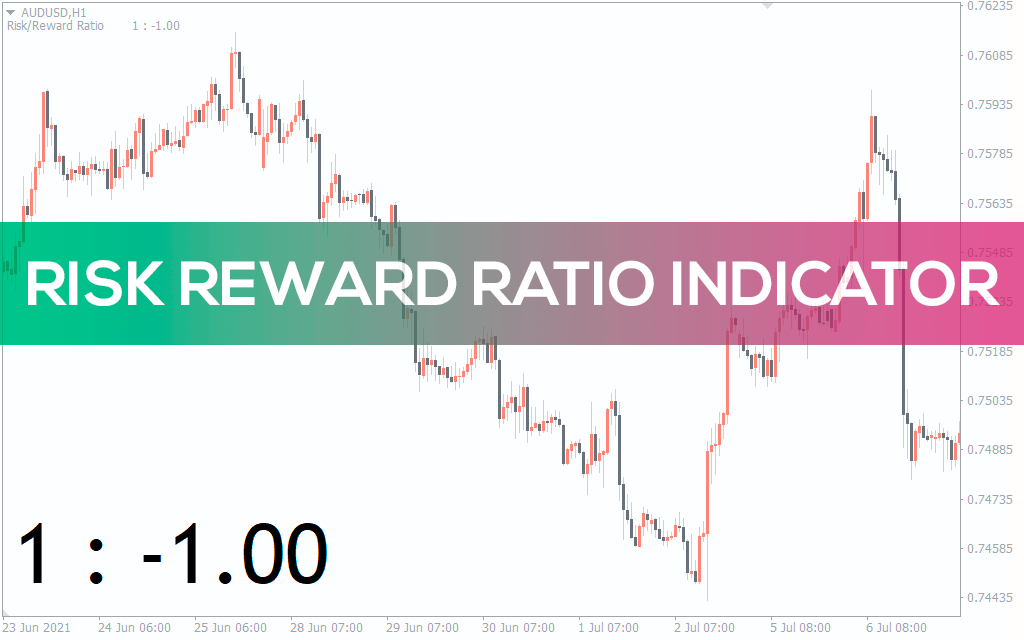
The Risk Reward Ratio Indicator enables traders to determine the level of exposure to risk and its reward.
Description
The key to becoming a successful, profitable trader is in risk management. The best way to manage trading risk in forex is applying the Risk to Reward Ratio (RRR).
As important as this risk management is, many traders have difficulty in calculating it. This difficulty is eliminated using the Risk Reward Ratio Indicator.
Other tools on our website complement this strategy beautifully — the PZ Risk Management Indicator and the Position Size Calculator Indicator are a perfect pair for those traders who want to fine-tune position sizing and risk management with confidence.
The Foundation
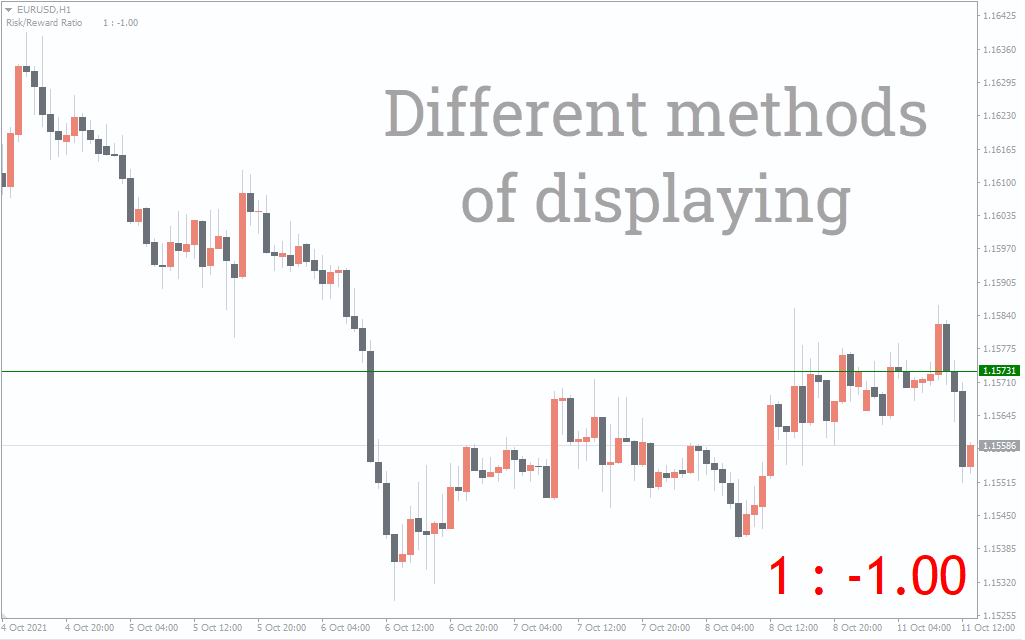
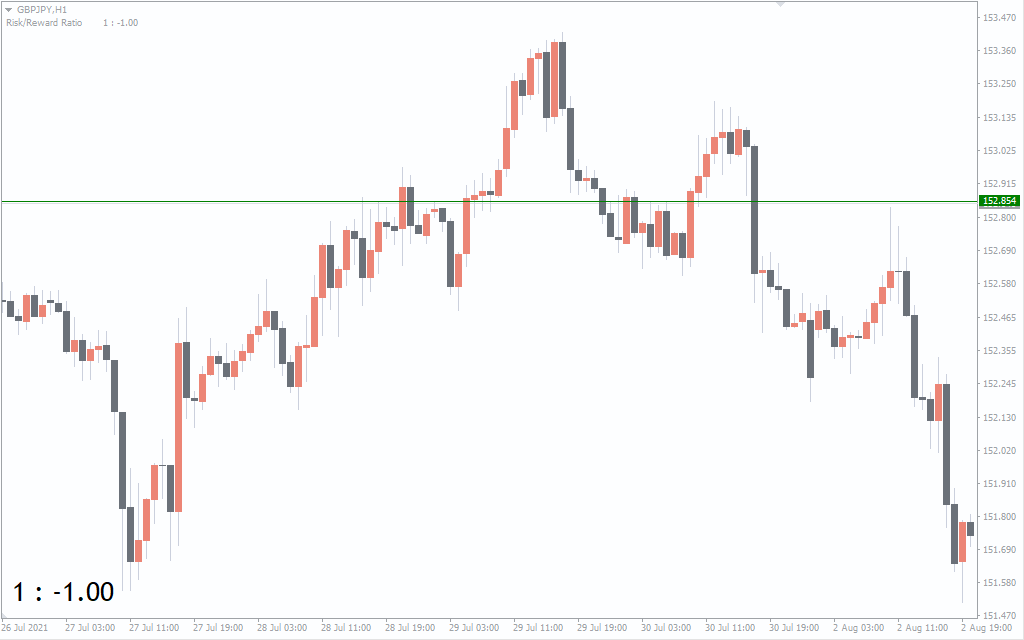
The Risk Reward Ratio Indicator enables traders to determine the level of exposure to risk and its reward. This indicator is displayed on the main chart as a ratio as seen in the diagram below:
From the EUR/JPY H1 chart above, the RRR as displayed by the indicator is 1:1.94. The first number (1) is the risk, while the second number (1.94) is the reward.
In addition to this, the indicator displays three horizontal lines. The first line is the take-profit price level (green horizontal line). The second line is the stop loss price level (red horizontal line). Finally, the third line displayed on the chart (grey horizontal line) is the bid price.
It’s a feeling of control for me to drag these lines manually, and in my experience it’s very awesome. I adjust my stop loss slightly based on nearby support zones, and the indicator reports the ratio instantly — I find it easier to gauge trades against my actual risk appetite.
The Risk Reward Ratio Indicator for MT4 is calculated using the following method:
The risk is the differences between the entry and the stop loss in trade.
- For long trades, risk = Entry price – SL
- For short trade, risk = SL – entry price
- The reward is the difference between the entry and TP.
- For long trades, reward = TP – Entry
- For short trades, the reward is Entry – TP.
The RRR is the reward divided by the risk (reward/risk).
For example, if you entered USD/JPY long trade at 125.22, and you set your SL and TP to 122.11 and 128.54 respectively, since it’s a buy trade, your risk is
Entry – SL= 125.22-122.11= 3.11
Your reward is
- TP- Entry= 128.54-125.22 = 3.32.
- Risk is 3.11 and the reward is 3.32.
- RRR = reward/risk = 3.32/3.11 = 1.1
- Therefore, RRR = 1:1.1.
I’ve found, once you begin to approach things in RRR terms, not only pips or dollars, discipline drastically improves. Even when I have a few losing trades (say 1:2 or greater), my long-term profitability is constant, when I maintain my RRR constant.
How to use the Risk Reward Ratio Indicator
To effectively use the Risk Reward Ratio Indicator for MT4, you must first enable the 3 horizontal lines on the chart.
After dragging the indicator to the chart, press CRTL B, then mark the 3 icons as shown below.
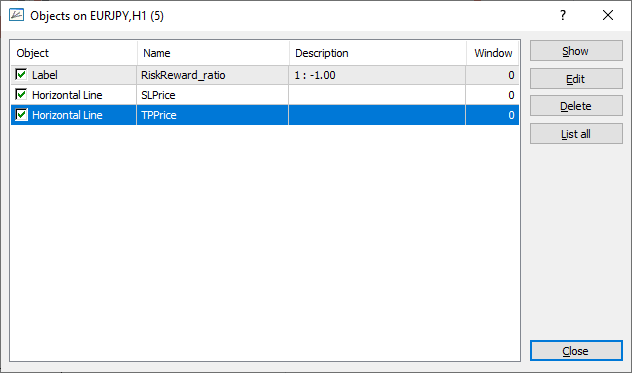
The three horizontal lines will be displayed on the chart once these icons are marked. You can also drag the stop-loss and take-profit levels to plan where your risk reward for each trade should be. The indicator will automatically display the RRR as the stop-loss and take-profit levels are being adjusted.
For long trades, the TP level (green horizontal line) should be placed above the entry point. Contrarily, the SL level (red horizontal line) should be placed below the entry point.
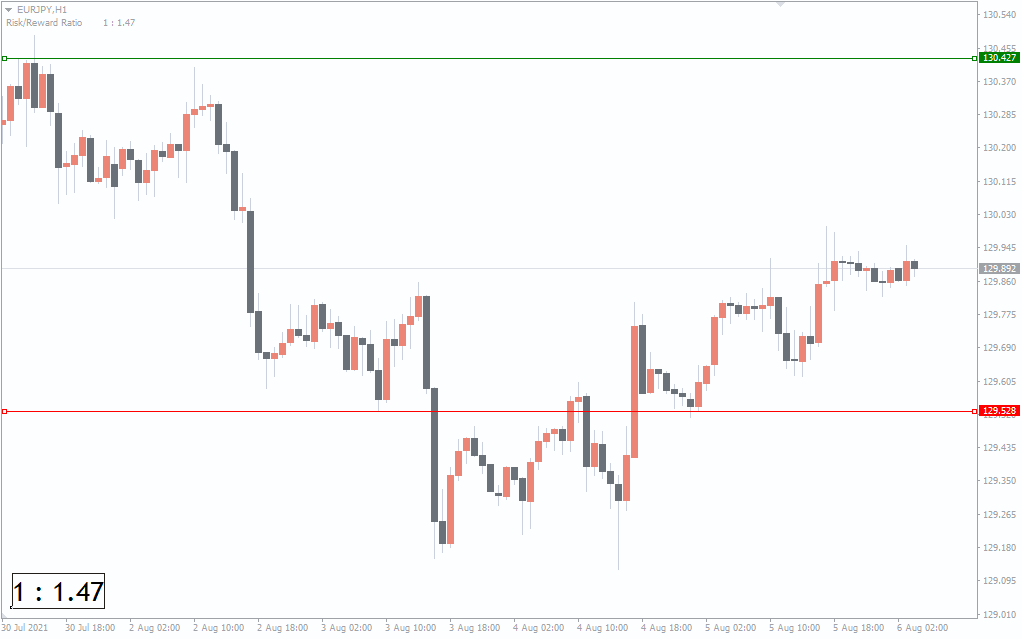
For short trades, the TP level (green horizontal line) should be placed below the entry point. The SL level (red horizontal line) on the other hand, should be placed above the entry point.
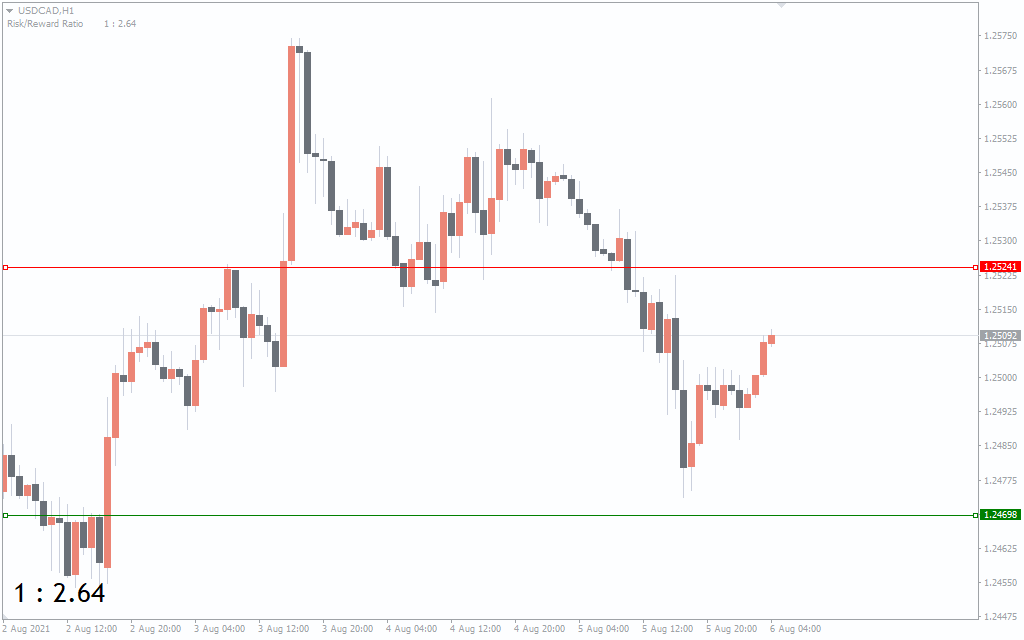
With this indicator, traders can differentiate between good and bad trades. Good trades will have at least a RRR of 1:2. Bad trades on the other hand, will have RRR value less than 1:2.
For 1:2 RRR, it means if you take a risk of 1, your profit will be 2 times your risk. Also, 1:3 means if you take a risk of 1, your reward will be 3 times your risk. This means if your SL is 30 pips, your profit will be 3×30 pips, that’s 90 pips for 1:3. For 1:2 if your SL is 30 pips, it means your profit will be 30×2 = 60 pips.
That’s why this indicator is so important to analyze your risk to reward ratio before triggering any trade.
Pros and Cons of the Risk Reward Ratio Indicator
 Pros
Pros
- Quick, precise RRR calculation on the chart straight from the source of the calculation.
- Eye-catching and beginner- and professional-friendly to look at.
- Promotes disciplined, risk-conscious trading behavior.
- User-friendly and adjustable via manual TP/SL updates.
 Cons
Cons
- Does not automatically recommend SL/TP levels: The trader must still have discretion.
- Not always appropriate in scalping applications, especially in cases where a lot of quick, tight stops are frequent.
- Requires consistent manual adjustments if you move your orders often.
Conclusion
The Risk Reward Ratio Indicator for MT4 is a very useful tool for all forex traders. This indicator enables traders to determine the level of risk exposure to risk if the price moves against them, as well as it’s reward if the price moves in their favor.
For traders constantly experimenting with new tactics and configurations, we recommend exploring our new article on the Eagle Scalper Indicator where we highlight a state-of-the-art scalping tool that complements risk-based systems as one of its key assets.
Frequently Asked Questions (FAQ)
 Does the indicator automatically adjust when I change my SL or TP?
Yes, it updates the ratio in real time as you move your stop loss or take profit lines.
 Can I use this indicator on crypto or indices?
Yes, it works on all MT4 instruments — forex, crypto, metals, or indices.
 What’s the ideal RRR to aim for?
Most professionals target at least 1:2 or 1:3, depending on their trading strategy.
 Does it repaint or change past values?
No, it simply recalculates based on your current levels and doesn’t repaint history.
 Is it beginner-friendly?